
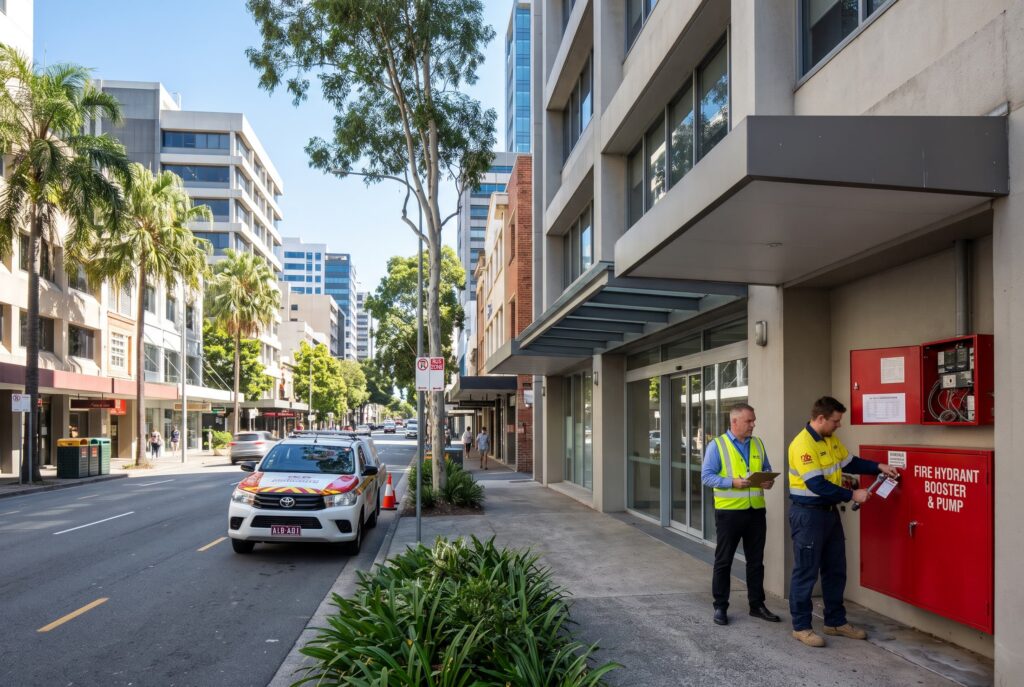
Queensland handles building fire safety a little differently to NSW and Victoria. There’s no council lodged annual fire safety statement. Instead, the responsibility sits with the building’s occupier, who must keep fire safety installations maintained, hold the records to prove it, and lodge an occupier’s statement with the Queensland Fire Department each year. On top of that sit ongoing duties around fire and evacuation planning.
For commercial building owners, owners corporations and asset managers in Brisbane and South East Queensland, it’s a system that works well when it’s managed as a year round program and becomes stressful when it isn’t. This guide sets out what’s required and how to stay on top of it.
Who Is Responsible for Fire Safety in a Queensland Building?
In Queensland, the key duties fall on the occupier of the building, not just the owner. In practice:
- If a tenant occupies the building, the tenant is generally responsible for maintaining the fire safety installations in its tenancy.
- If the owner occupies the building, the owner is responsible.
- In multi tenancy buildings, each occupier usually looks after installations within its own tenancy, while the building manager or owner looks after common areas and installations serving the whole building.
- In a body corporate, the body corporate decides who is authorised to sign the occupier’s statement for common property and can contract an appropriately licensed person to carry out maintenance.
Because responsibility can be split across several parties, one of the most common compliance gaps in Brisbane commercial buildings is simply nobody being clear on who owns which part. A good facilities management partner closes that gap by mapping every installation to a responsible party.
Maintaining Prescribed Fire Safety Installations Under MP 6.1
Queensland Development Code MP 6.1, Commissioning and maintenance of fire safety installations, sets out how prescribed fire safety installations must be maintained. It applies to Class 1b and Class 2 to 9 buildings, including existing buildings, which covers apartment buildings, offices, retail, warehouses, factories and health and aged care facilities. Detached houses and their sheds and garages are excluded.
Prescribed fire safety installations typically include:
- Fire detection and alarm systems
- Sprinkler systems, fire hydrants and hose reels
- Emergency lighting and exit signs
- Fire doors and smoke control systems
- Portable fire extinguishers and fire blankets
Each installation must be maintained in line with the relevant standard or recommendation, and the occupier must keep a record of that maintenance.
The Annual Occupier’s Statement
Each year, the occupier must prepare an occupier’s statement confirming that the building’s prescribed fire safety installations have been maintained in line with the relevant standard. The key points:
- The first statement is due within one year of the occupier taking up occupation, then within one year of the previous statement.
- A copy must be given to the Commissioner of the Queensland Fire Department within 10 business days of the due date, either to the regional office or by email.
- A copy is kept with the building’s maintenance records, which should be retained for at least two years.
- Failing to prepare, keep or lodge the statement can each attract penalties, and fire officers can audit buildings and issue on the spot fines.
Fire and Evacuation Planning Duties
Maintenance is only half of the picture. Under the Building Fire Safety Regulation 2008, occupiers must also:
- Keep a written fire and evacuation plan, including an evacuation diagram and details of how the building’s firefighting equipment and alarms operate
- Review the plan at least once a year, and update it within a month of any change in circumstances
- Give workers general evacuation instructions, including new starters within a short timeframe of starting, and provide first response evacuation instructions
- Run an evacuation practice at least once a year
For commercial buildings with several tenants, this needs real coordination. Each tenancy’s workers need instructions and the building needs a consistent evacuation process that everyone actually follows.
A Fire Safety Compliance Checklist for Brisbane Building Owners
- Confirm who the occupier is for each part of the building and who is authorised to sign each occupier’s statement
- Check the list of prescribed fire safety installations matches what is actually installed
- Make sure maintenance contracts reference MP 6.1 and the relevant standards, and are carried out by appropriately licensed people
- Keep a single, up to date maintenance logbook with service reports and defects, stored with the fire safety management plan
- Diarise each occupier’s statement due date and lodgement deadline
- Review the fire and evacuation plan annually and after any fit out, refurbishment or change of use
- Schedule the annual evacuation practice and keep records of instructions given to workers
Why a Proactive, Data Driven Approach Makes Compliance Easier
Fire safety compliance in Queensland is ongoing by design. Installations need regular servicing, plans need regular review, and the occupier’s statement simply confirms the work was done. When maintenance is planned and tracked all year, lodging the statement is a formality.
Predictive, sensor based monitoring helps keep it that way. A fire pump or other critical plant running outside its normal range can be flagged well before it fails, and live dashboards give owners and asset managers real time visibility of servicing, defects and upcoming deadlines across a single building or a whole portfolio. That matters in Brisbane, where storm season already puts extra demand on essential services from October to April.
How National Facilities Management Supports Brisbane Buildings
National Facilities Management has more than 40 years of experience helping owners protect asset value and keep buildings compliant across Brisbane, Sydney and Melbourne. Our Brisbane facilities management team manages essential services and fire safety compliance for commercial, high rise, strata and build to rent buildings, with an approach built on:
- Directly employed core facilities management teams, trained to our standards and accountable to us. For specialist fire protection services, we engage appropriately licensed contractors under the same quality and compliance standards and manage that work on the owner’s behalf.
- Planned preventative maintenance backed by predictive data, sensor based insights and live dashboards, so owners always know where their building stands.
- Coordination of the full compliance cycle, from installation servicing and defect rectification to occupier’s statements, evacuation plans and annual practice drills.
Frequently Asked Questions
1. Does Queensland have an annual fire safety statement like NSW?
Not in the same form. Instead of a statement lodged with council, Queensland requires the occupier to prepare an annual occupier’s statement confirming fire safety installations have been maintained, and give a copy to the Commissioner of the Queensland Fire Department.
2. Who signs the occupier’s statement in a commercial building?
The occupier of the building or tenancy signs it. If there is no occupier, the owner signs. In a body corporate, the body corporate decides who is authorised to sign for the common property.
3. What is MP 6.1?
MP 6.1 is the part of the Queensland Development Code covering commissioning and maintenance of fire safety installations. It applies to Class 1b and Class 2 to 9 buildings, including existing buildings, and sets out which installations must be maintained.
4. How often do we need to run an evacuation practice?
An evacuation practice must be held at least once a year, and the fire and evacuation plan must be reviewed at least annually and updated within a month of any change in circumstances.
5. How long should fire safety maintenance records be kept in Queensland?
The occupier’s statement and maintenance records should be kept together for at least two years, ideally with the building’s fire safety management plan so they’re ready if a fire officer audits the building.
Make Fire Safety Compliance One Less Thing to Worry About
If you’re not certain who holds which fire safety duties in your building, or whether your records would stand up to an audit, now is a good time to check. National Facilities Management works with owners, bodies corporate and asset managers across Brisbane, Sydney and Melbourne to keep buildings safe, compliant and performing, with more than 40 years of experience backing us.
Contact us to arrange a fire safety compliance review for your Brisbane building.